Delivery fills the calendar.
BD disappears.
Pipeline follows.
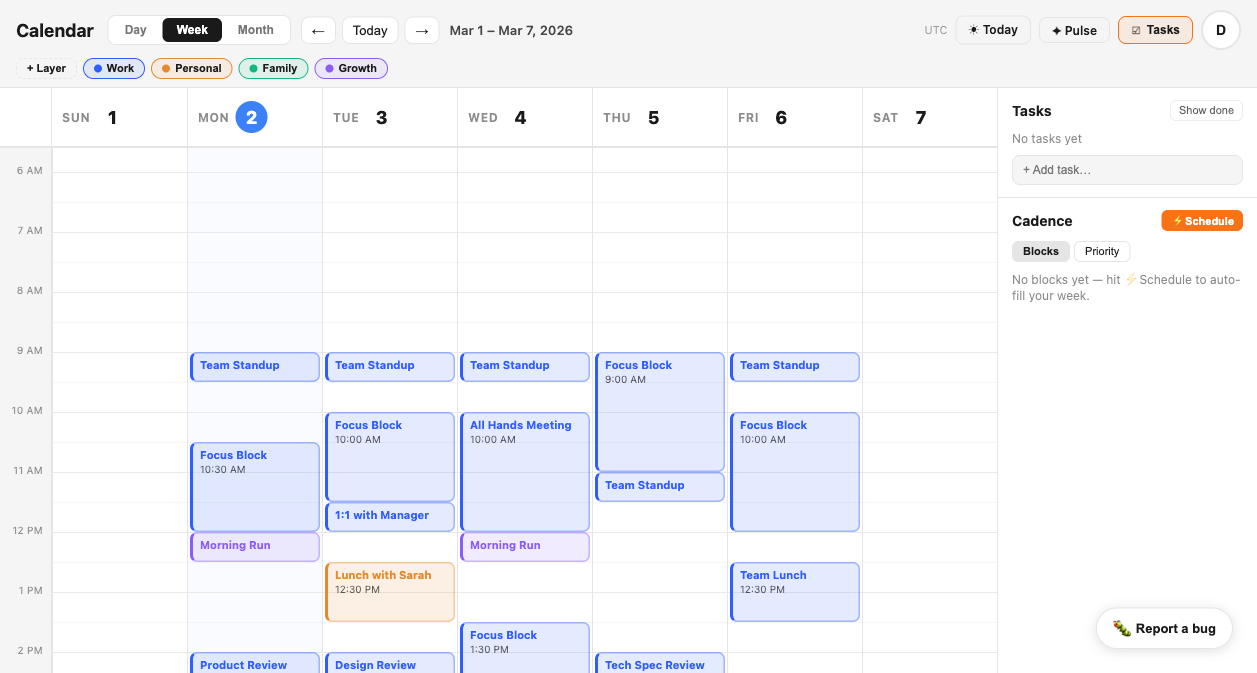
A coaching practice runs on your calendar — but the calendar treats a client session, a BD call, an admin task, and personal time as identical events. There's no way to see how hours are actually distributed across delivery, development, and yourself. The business math stays invisible. The categories without fixed appointments get crowded out first — and silently.
Tempo analyzes your practice across four categories. Client Sessions, Business Dev, Admin, Personal — tracked as distinct percentages, week over week, with SIGNAL alerting when the composition drifts before it becomes a problem you can feel.
Client sessions have your calendar.
BD has nothing.
Client sessions are fixed commitments that always show up. Business development — content, outreach, discovery calls, pipeline work — is optional until it isn't. Once delivery fills the calendar, BD quietly disappears. A full roster feels permanent until it isn't. Tempo surfaces the gap before it becomes a revenue problem.
A coaching practice lives on a personal calendar, and the boundary erodes fast. A client check-in and a personal appointment look identical. An evening session and personal time look the same. Without visible separation, the boundary exists only in your head — until burnout makes it physical.
Discovery calls, program prep, admin follow-up, and content creation are real time — but most of it isn't billable. Without separating them, the ratio stays invisible. You can feel productive all week and be running 40% billable. Tempo shows the number before you estimate it.
Built for how a coaching practice actually runs.
Client Sessions, Business Development, Admin, and Personal Renewal require different conditions and carry different consequences when they fall out of balance. Tempo analyzes each separately — so you see not just what's on the calendar, but whether the composition matches the practice you're trying to build.
Every billable client interaction — coaching calls, check-ins, intensive sessions, group programs. Tracked separately so you see your actual delivery percentage each week — not what the calendar looks like, but the number. Is 70% of your week delivery? 45%? Tempo shows you.
Discovery calls, content, outreach, partnerships, pipeline work. The investment that sustains the practice — and the first category delivery crowds out. SIGNAL alerts when BD has been absent long enough that your pipeline is at risk.
Scheduling, invoicing, contracts, onboarding, and operations. Non-billable and necessary. Tracked separately so you can see the actual overhead load each week — and whether it's eating into client or BD time without announcing itself.
Your training, rest, and life outside the practice. Coaches who don't protect this eventually have nothing to give clients. Tempo makes its erosion visible — and SIGNAL catches the drift before burnout makes the decision for you.
SIGNAL catches the pipeline risk before you feel it.
Client Sessions at 65%, Business Development at 5% — the implication is immediate. You're fully loaded on delivery and barely investing in the pipeline that sustains it. A strong month of client work can mask an empty pipeline for months. By the time you notice, the cost is already in motion. Tempo surfaces the pattern first.
SIGNAL watches your time composition weekly — alerting when BD has been consistently displaced, or when personal renewal has dropped to a level that predicts burnout. The alert finds you in your PULSE. Not a report you remember to check. A signal that arrives before another week runs the same way.
Four categories. Real percentages. Your practice — finally visible.
What you get that you don't have now.
A full coaching calendar
isn't a healthy one.
Know the difference.
Connect your calendars in two minutes. Tempo analyzes your practice across delivery, development, admin, and personal time — SIGNAL watching for BD gaps and renewal erosion, PULSE delivering the honest picture of your week before the drift becomes a problem you can feel.