3 clients. 2 proposals.
1 calendar that shows
none of it clearly.
Consultants operate across multiple clients, time types, and business phases simultaneously. Client work, BD, admin, and personal time all live in the same calendar — and look exactly the same. Without visibility into the composition, your billable percentage is always a guess and the drift from billable toward overhead is always invisible until it costs you.
Tempo analyzes every time type as a distinct category. You see where the hours actually went — and SIGNAL alerts you when the balance is shifting before it shifts too far.
When every hour type looks the same,
the billable ratio is invisible.
A proposal review, a client kickoff, and an internal admin task share the same visual weight on any calendar. There's no signal in the noise. You can't see the composition of your week — only a list of what happened, with no indication of what it cost.
Knowing whether you hit 70% billable last week means manually tallying event durations across categories. Nobody does that consistently. The ratio stays invisible, non-billable time quietly expands, and the drift only surfaces at month-end when it's already locked in.
A proposal due Friday and a client check-in on Thursday look identical in the calendar. Neither signals which one is at risk when the week fills around them. The pressure builds without warning until something slips.
A contract to review. An invoice to send. A proposal to format. Each one is small. Over weeks, they accumulate — and a quarter of your billable capacity gets quietly reallocated to overhead that never announced itself.
Built for how a consulting practice actually runs.
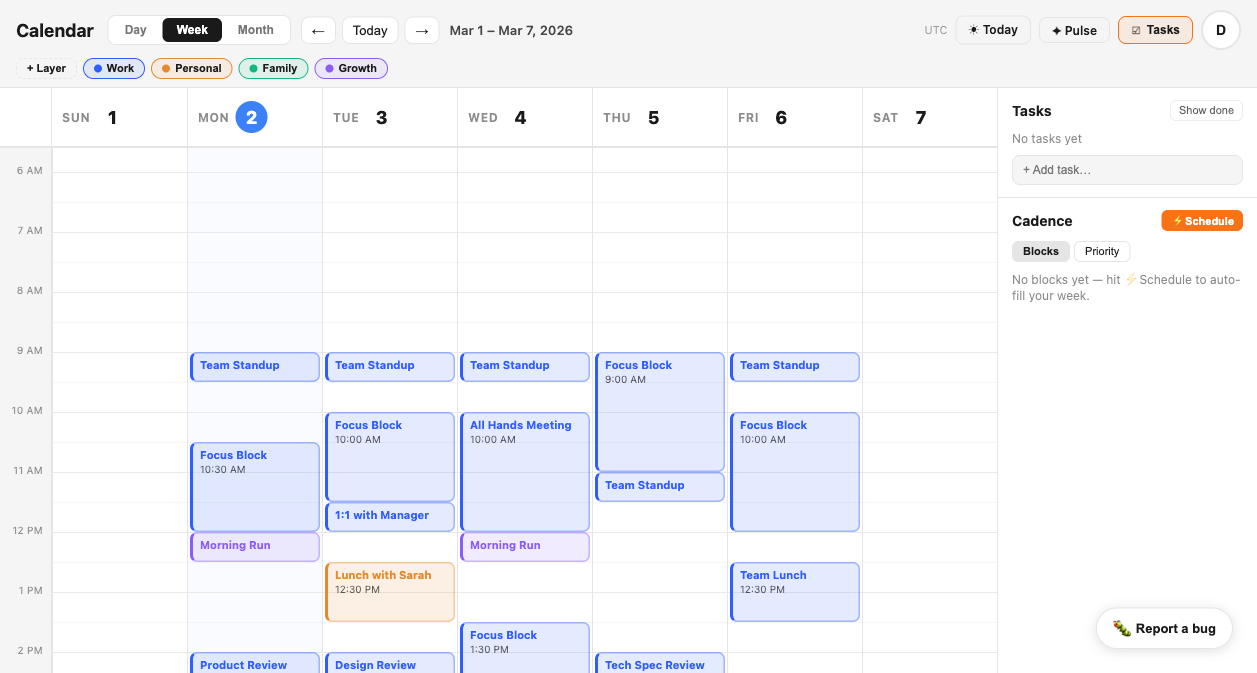
Every time type in a consulting week gets analyzed separately. You see your hours distributed across billable work, BD investment, admin overhead, and personal time — and SIGNAL catches where the composition is drifting before it costs you a month.
Every billable hour — client calls, deliverable reviews, on-site work, project execution. Analyzed as its own category so your billable ratio is always visible in real time — not buried in a mixed list, not estimated at month-end.
Proposals, networking, prospect calls, and follow-ups. BD is investment, not overhead — and it needs to be visible so you can see what you're putting in versus what client work it generates over time.
Invoicing, contracts, scheduling, and business operations. Non-billable by nature, necessary in practice. The category SIGNAL watches most closely — because it's the one that silently encroaches on billable capacity week after week.
Life outside the practice. Analyzed separately so the full picture is visible — including when client or admin time expands into personal space and the boundary disappears without you choosing it.
SIGNAL catches admin drift before it becomes a billing miss.
Admin at 30% of your week. Client Work at 45%. The implication is immediate — you're spending nearly as much time on overhead as on the work you bill for. That ratio doesn't surface in a standard calendar. It only shows up as lower-than-expected revenue and a vague feeling that something is off. Tempo makes it concrete.
SIGNAL watches your time composition and alerts you when non-billable overhead crosses a threshold. Not a dashboard to remember to check — a signal that finds you in your weekly PULSE before another week drifts the same way.
Where your hours actually went —
not where you thought they went.
Every week, PULSE delivers the real picture — billable hours as a percentage of total, which clients consumed the most time, how much went to BD, whether admin is creeping. Not the plan. The actuals. Grounded in your calendar data with no manual logging required.
For consultants who bill by the hour or project, this visibility is the difference between pricing work accurately and consistently undercharging for what it actually takes.
Four categories. Real percentages. Your billable ratio — visible now.
What you get that you don't have now.
Stop guessing your
billable percentage.
Tempo shows you.
Connect your calendars in two minutes. Tempo analyzes your time across client work, BD, admin, and personal — SIGNAL watching for billable drift and admin overruns, PULSE delivering the real picture of your week before another month closes at the wrong number.