One meeting can kill
a whole afternoon
of deep work.
Flow state takes 23 minutes to regain after an interruption. A 30-minute standup in the middle of your afternoon doesn't cost 30 minutes — it costs the full context on both sides. Eight hours logged. Nothing shipped. Your calendar shows a productive day. It doesn't explain why it wasn't.
Tempo detects when meeting placement is fragmenting your focus windows — and CADENCE automatically protects the blocks that can actually support build time. Put your calendar to work.
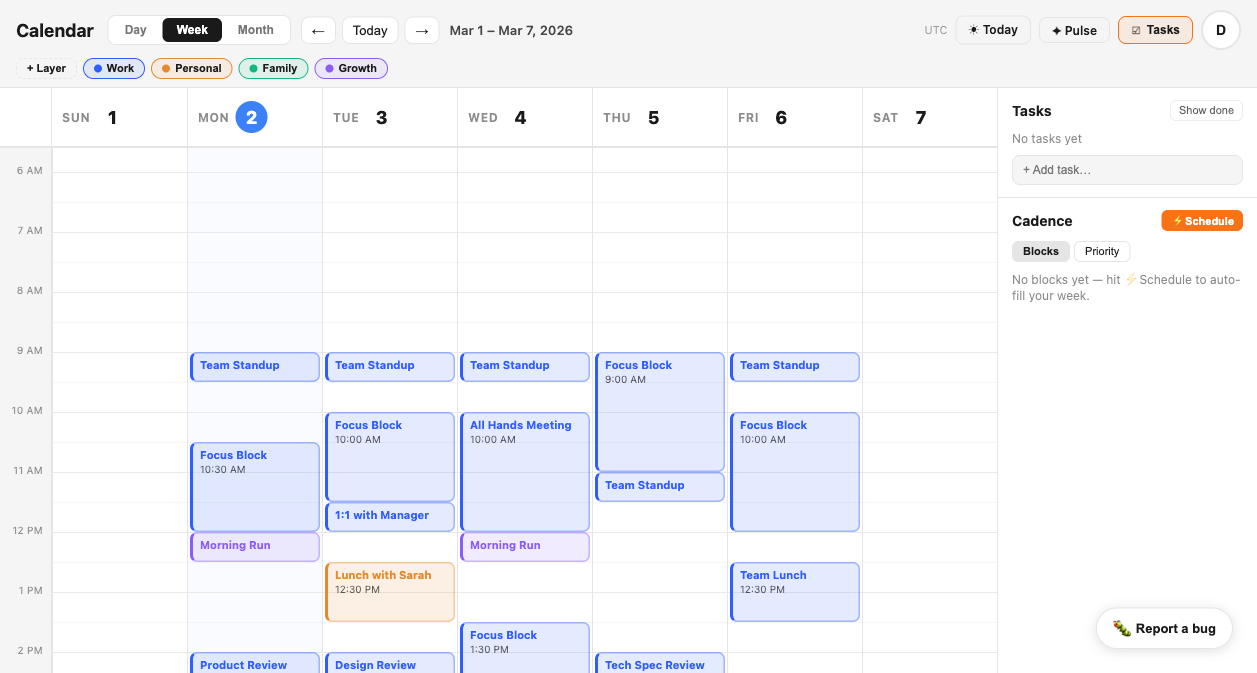
The calendar looks open.
The gaps aren't long enough to matter.
It takes 23 minutes to fully regain focus after an interruption. A 30-minute standup at 10am doesn't cost 30 minutes — it costs the 90-minute block before it and the hour after. One meeting can make a whole morning unproductive. Tempo quantifies that cost. Standard calendars don't.
Meetings at 9:30, 11:00, 2:00, 4:00 — the calendar looks open. In practice it's a series of 60-90 minute islands, none long enough for deep work. Together they hollow out the day. CADENCE identifies genuine open windows and protects them before anything else fills them.
Review cycles, design sessions, and incident post-mortems are necessary — but they compete with focused implementation for the same calendar real estate. Without separating them, you can't see which is winning until velocity drops.
On-call weeks are fundamentally different. Without tracking them separately, they blend into the normal schedule and make everything unoptimizable. Every week looks different. No pattern is detectable. SIGNAL can't tell signal from noise.
Four categories. One honest picture of your week.
Build, Meetings, Review, and Growth don't just feel different — they require different conditions and carry different consequences. Tempo analyzes each separately so the ratio is always visible, fragmentation is always detectable, and CADENCE can actually protect the time that matters.
Deep implementation, feature work, bug fixes, technical spikes. The category CADENCE protects and SIGNAL monitors most closely. When Build time shrinks, you get an alert with trend data — before the sprint falls behind and you're explaining it in retro.
Standups, planning sessions, incident reviews, cross-team syncs. Analyzed separately from build time so the real ratio is always visible — and fragmentation patterns surface before they become delivery problems.
Code reviews, PR walkthroughs, design reviews, architecture discussions. Separated from meetings and build so you can see the actual review overhead in your schedule each week — not guessed, measured.
Learning, docs, internal talks, conference prep, side projects. The easiest category to eliminate entirely. Analyzed separately so you can see when it has been absent from your schedule for weeks — and decide if that's intentional.
Detect fragmentation. Protect build time.
Automatically.
SIGNAL watches your calendar for fragmentation — meetings placed in positions that destroy the gaps on either side, stretches without a single 2-hour build block, Build time collapsing below baseline. Alerts surface in your Executive Brief before you hit the wall.
CADENCE goes further. It reads your real schedule, identifies genuine open windows — not slots that look open but are surrounded by meetings — and automatically schedules protected focus blocks into the time that can actually support deep work.
Together, they mean you don't audit your schedule every Sunday night. Tempo does it — and surfaces the problems before they've already cost you a sprint.
What you get that you don't have now.
Your best code needs
uninterrupted time.
Tempo protects it.
Connect your calendar in two minutes. Tempo analyzes build time versus meetings versus review — SIGNAL detecting fragmentation before you feel it, CADENCE scheduling the focus blocks that can actually hold, Executive Brief waiting before your first standup.