Your calendar fills itself.
The question is whether it
reflects your strategy.
At the executive level, demand for your time always exceeds supply. Meetings propagate, escalations land, and the operational surface expands to fill whatever is available. Without visibility into how that time is actually allocated — strategic vs. operational, external vs. internal — you have no way to know if your calendar reflects your stated priorities.
Tempo analyzes every category of executive time and delivers an Executive Brief before your day starts — so you lead with intention, not just react to what the calendar brought you. Put your calendar to work.
Operational fills the space.
Strategy doesn't protect itself.
Urgent always beats important in an unstructured calendar. Escalations, status updates, and one-off requests displace strategy sessions and deep-thinking time. They do it gradually enough that you don't notice until the strategic work simply isn't happening — and Q3 ends with nothing moved.
Team obligations are real and necessary. But when they collectively consume 60% of available hours, the time left for forward-looking work is a rounding error. Tempo tracks the ratio so you can manage it — instead of discovering it at the end of the quarter.
How much of your week faces customers, partners, and the market — versus facing inward? Most executives can't answer without manually auditing their calendar. The data exists. Tempo surfaces it automatically, every week, before the pattern becomes a strategic liability.
The strategic initiative is the top priority. Your calendar shows three times more time on operational reviews than on strategy. Both things can't be true. The calendar is the truth. Tempo shows you exactly which story it's telling.
Analyzed for how an executive's time actually works.
Every category of executive time is analyzed separately. Strategic and operational are distinct. External and internal are tracked independently. The composition of your week becomes visible — and the misalignment between stated priorities and actual allocation becomes impossible to ignore.
Planning sessions, strategy reviews, long-horizon thinking, and investment decisions. Should be non-negotiable — and is typically the first category operational pressure crowds out. SIGNAL watches this one specifically and alerts you when it drops below your threshold.
Status updates, escalations, reviews, and the day-to-day surface of running an org. Necessary — but its ratio to Strategic time is the signal that matters most. Tempo makes that ratio visible every week.
1:1s, staff meetings, performance conversations, and the investment you make in your direct reports. Analyzed separately so you can see how much you're putting in — and whether it matches the team investment your goals require.
Customer calls, board interactions, partner meetings, and market-facing time. Analyzed separately from internal time so the external/internal ratio is visible — not buried in a combined list of meetings.
SIGNAL alerts when strategic time drops.
The Brief arrives before it gets worse.
Strategic time at 9% of a week. Operational at 32%. Your calendar is telling you something your quarterly goals aren't. That mismatch doesn't surface in a standard calendar — it only shows up at quarter-end when the strategy work hasn't moved and nobody can articulate why. Tempo surfaces it in week one.
SIGNAL watches your thresholds and alerts when strategic time drops below your floor — monitoring meeting density, external/internal ratio, and burnout risk simultaneously. Everything surfaces in your Executive Brief before the day fills in around you.
The composition of your day —
delivered before it starts.
Every morning before your first meeting, the Executive Brief synthesizes everything across your connected calendars — meeting load, time distribution by category, focus blocks scheduled, and one line of insight about how the week is shaping up. Thirty seconds. Full picture. Nothing assembled manually in your head.
Executives who have spent years constructing the mental model of a day from fragments scattered across apps — this is what it looks like when that work disappears.
See how your week is actually allocated.
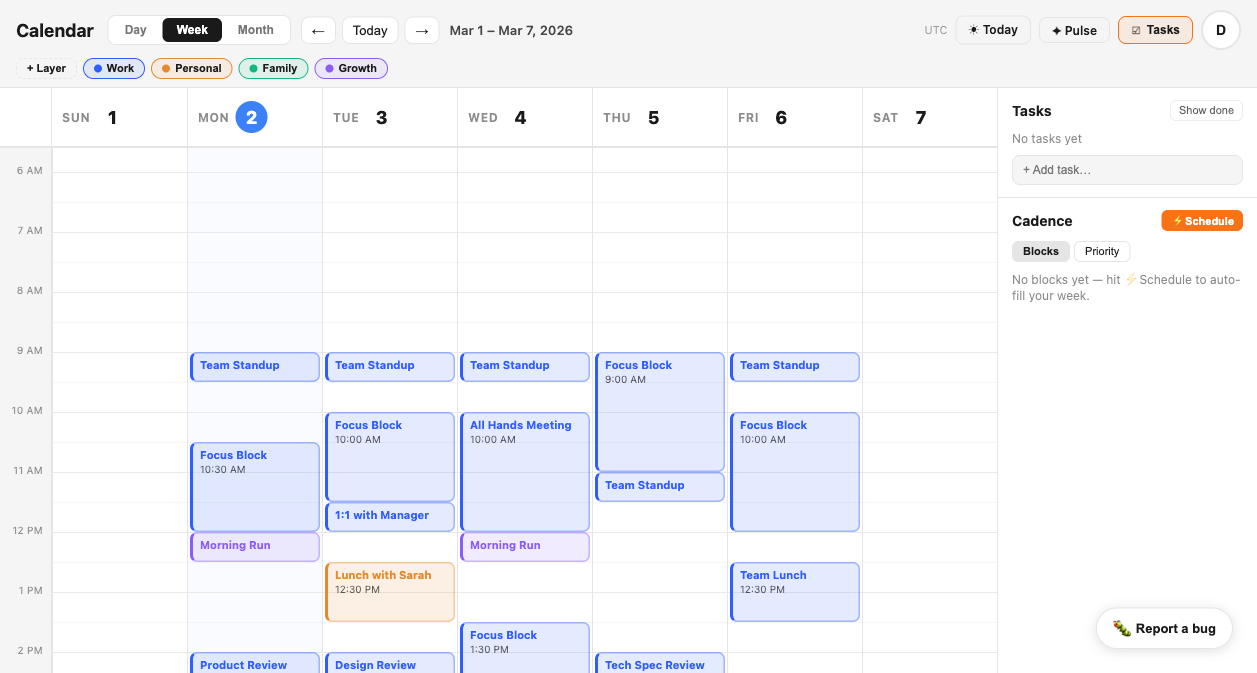
What you get that you don't have now.
Your time is strategy.
Start treating it that way.
Connect your calendars in under two minutes. Layers organized by Strategic, Operational, Team, and External time. SIGNAL alerting when the ratio drifts. The Executive Brief waiting every morning before your day begins.