Your calendar is your strategy.
Tempo shows you what it
actually says.
The deck says product-led. The strategy memo says customers first. But the calendar says ops and investor calls consumed 62% of last week. Most founders never see that number — not because it doesn't exist, but because no tool shows the breakdown.
Tempo analyzes your time across Fundraising, Product, Customers, and Team — and surfaces the allocation drift before it costs you a quarter.
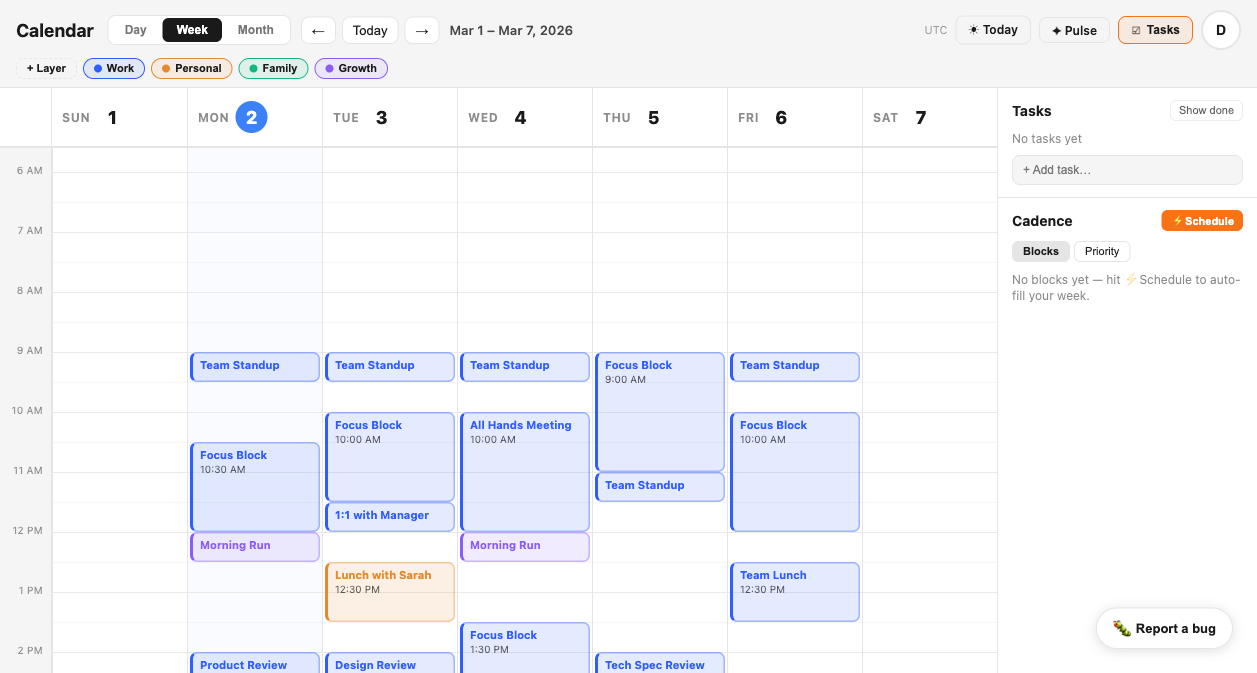
The allocation drift is invisible
until Tempo measures it.
Hiring calls, vendor reviews, compliance work, accounting check-ins — none of them feel urgent individually. Together they consume 35-40% of the week before you notice. Tempo shows the ratio before three weeks of compounding ops work disappears into the quarter.
A raise should consume 40-60% of your week during the process. The problem is when it doesn't stop there. Investor relationship management expands invisibly into the months that were supposed to be product-heavy. Tempo detects the bleed.
Five 45-minute interviews don't feel like a full day. They are. Customer calls get deprioritized, pipeline slows, and the calendar reflects a recruiting-heavy company when your Q2 strategy called for customer density. SIGNAL catches it.
Your strategy says product. Your calendar says ops. Without a layer breakdown, you only discover the drift at the quarterly review — when the cost is already sunk. Tempo surfaces the misalignment before it becomes a retrospective.
Every surface of the company.
One layer each.
Tempo analyzes every role a founder plays — not just what is scheduled, but how the week is distributed across Fundraising, Product, Customers, and Team. The breakdown is visible before the week runs, not after the quarter closes.
Investor meetings, LP updates, term sheet reviews, due diligence calls. Tempo tracks this as its own layer so you see exactly what percentage of the week a raise is consuming — and SIGNAL alerts when it bleeds past the active raise period.
Deep work, product reviews, roadmap sessions, engineering syncs. The layer most often crowded out first — and the one SIGNAL monitors most closely for sustained decline against ops and fundraising load.
Demos, onboarding, account reviews, support escalations, customer calls. Separated from investor work so Tempo can detect when customer time is being sacrificed for fundraising — and when the gap is growing across consecutive weeks.
Hiring loops, 1:1s, all-hands, leadership syncs, culture work. Its own layer so recruiting spikes become visible in aggregate — not invisible across five individual calendar entries that together consumed a full day.
Alerts when ops beats product.
Before you feel it.
SIGNAL watches your layer allocation continuously. The moment a pattern emerges that conflicts with your priorities — ops crowding product, investor calls bleeding past the raise period, a customer drought compounding across weeks — it surfaces the alert in your Executive Brief before the day starts.
This is not a dashboard you have to remember to open. It is intelligence that finds you — before the pattern has already cost you a month of momentum.
The most dangerous founder patterns are not single bad weeks. They are gradual drifts — three ops-heavy weeks while the product roadmap falls behind. SIGNAL catches the drift at week one, not at the quarterly retrospective.
See the allocation before
the week decides for you.
Every morning, the Executive Brief shows you the day ahead and the week in context — how time has been allocated so far across each layer, what SIGNAL is flagging, and where the week is trending relative to your priorities. Thirty seconds before the first meeting. Before the first fire.
For founders, the brief is a forcing function. It makes visible the gap between the allocation you intended and what the calendar is actually producing. You correct in the morning instead of discovering it at the end-of-quarter review.
Your strategy lives in your calendar. The Executive Brief makes that legible every single day — not as a retrospective, but as a live read of where the week is going and whether it matches where the company needs to go.
What you get that you don't have now.
Your calendar is your strategy.
Tempo makes that visible.
Connect your calendars in under two minutes. Layers organized by function — Fundraising, Product, Customers, Team. SIGNAL watching for allocation drift before it costs you momentum. Executive Brief waiting every morning with the real numbers.