Delivery fills the calendar.
BD disappears. Then the
pipeline does too.
Freelancers wear every hat simultaneously — delivery, business development, admin, and life outside work. Without a system to separate these, every hour type looks identical. The right work stops getting the right time and you don't notice until the project ends and the pipeline is empty.
Tempo analyzes the actual composition of your week across every role you play — and SIGNAL alerts you the moment the balance shifts away from where it needs to be.
Invisible until Tempo measures it.
Detectable before it costs you.
A two-hour block for your anchor client and a two-hour block for a low-rate client share the same visual weight. Without a layer separating them, the imbalance stays invisible until you're already underwater on the work that actually sustains the business.
Invoicing, proposal writing, contract reviews, and scheduling each feel small. Together they consume hours that were supposed to go to billable work. By the time the pattern is obvious, the week is already gone. Tempo shows the ratio before it costs you.
When active projects fill the calendar, BD gets pushed to after this deliverable. That becomes after this project. The project ends and the pipeline is empty. SIGNAL detects when BD has been dark for 5+ days and surfaces it before the gap becomes a revenue problem.
Freelance work expands to fill every hour a client could theoretically need. Without a Personal layer that makes the boundary real and visible, evenings and weekends quietly become extensions of the work week — and the erosion becomes a pattern before you notice it.
Every role you play
gets its own layer.
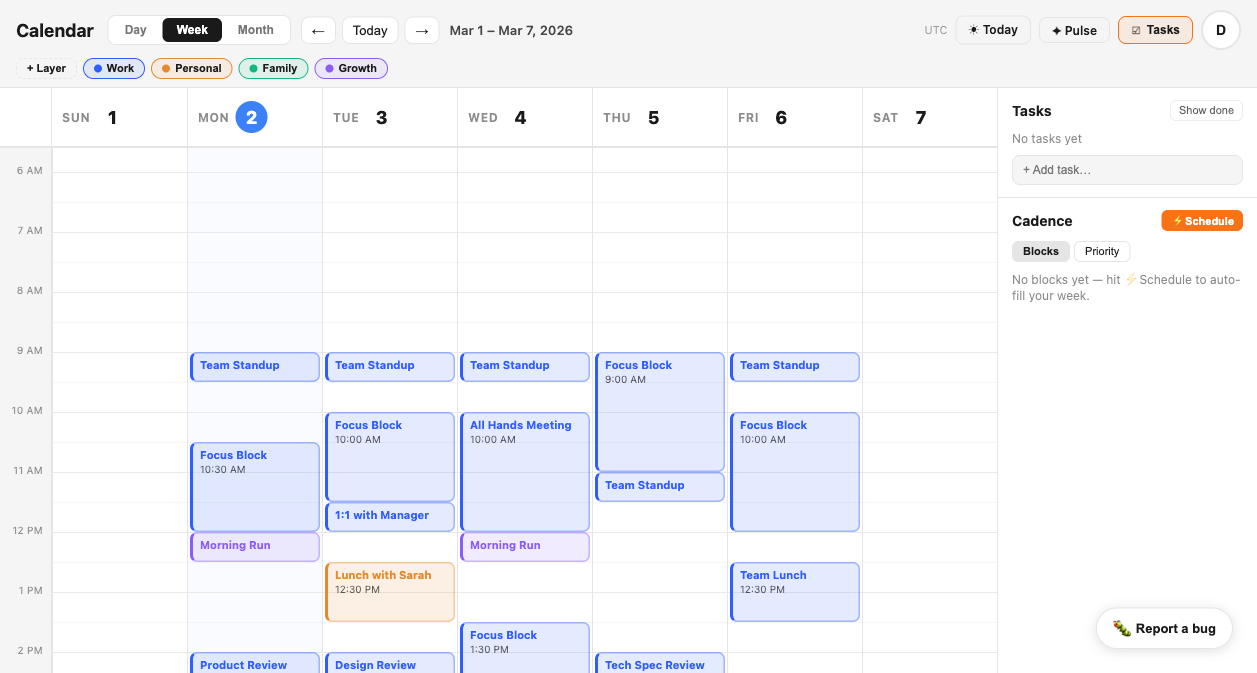
Client Delivery, Business Dev, Admin, and Personal are fundamentally different categories of time — but a standard calendar treats them identically. Tempo analyzes each separately so the composition of your week is legible at a glance, and the drift is detectable before it costs you another month of misallocated hours.
Every billable hour of actual client work — project execution, deliverable reviews, client calls, and handoffs. Tempo tracks this as its own layer so you see at a glance what percentage of the week is generating revenue versus everything else.
Prospecting, proposals, follow-ups, networking, and pitches. The layer that sustains the pipeline long-term — and the first to disappear during active delivery cycles. SIGNAL monitors this layer and alerts when it has been empty for 5+ days.
Invoicing, contracts, scheduling, tooling, and business operations. Non-billable overhead that is necessary but prone to silent expansion. Its own layer makes encroachment into delivery time detectable before it costs you a week of billable capacity.
Life outside the business. A dedicated layer makes the boundary real and measurable — and makes it detectable when client or admin work has displaced it, before the erosion compounds into a pattern that SIGNAL can no longer catch early.
Alerts when BD goes dark.
Before the pipeline does.
The most common freelancer pattern: active projects consume every available hour, BD drops to zero, and by the time the project winds down the pipeline is empty. It happens slowly, then all at once. SIGNAL detects when the Business Dev layer has been dark for 5+ days and surfaces the alert before the gap becomes a revenue problem.
SIGNAL also monitors admin time. When admin climbs above 25% of the week, it surfaces a warning — because at that level, non-billable overhead is meaningfully reducing your delivery capacity, and most freelancers don't see it until it has already been the pattern for weeks.
These are not dashboards you have to remember to open. They are signals that find you in your weekly PULSE before another week runs the same way.
See the composition of your freelance week instantly.
What you get that you don't have now.
See what is actually consuming
your freelance hours.
Connect your calendars in under two minutes. Layers organized by time type — Client Delivery, Business Dev, Admin, Personal. SIGNAL watching for BD gaps and admin overruns. PULSE delivering the honest picture of your week — not what you planned, but what actually happened to your hours.