Client work at 48%.
Firm obligations at 29%.
Most attorneys never see that.
Legal work is simultaneous by nature. Multiple matters, multiple deadlines, court appearances, depositions, internal meetings, and business development all compete for the same calendar — and on a standard calendar they look identical. No billable ratio. No signal when firm obligations crowd out client work. No visibility on whether BD has happened in two weeks.
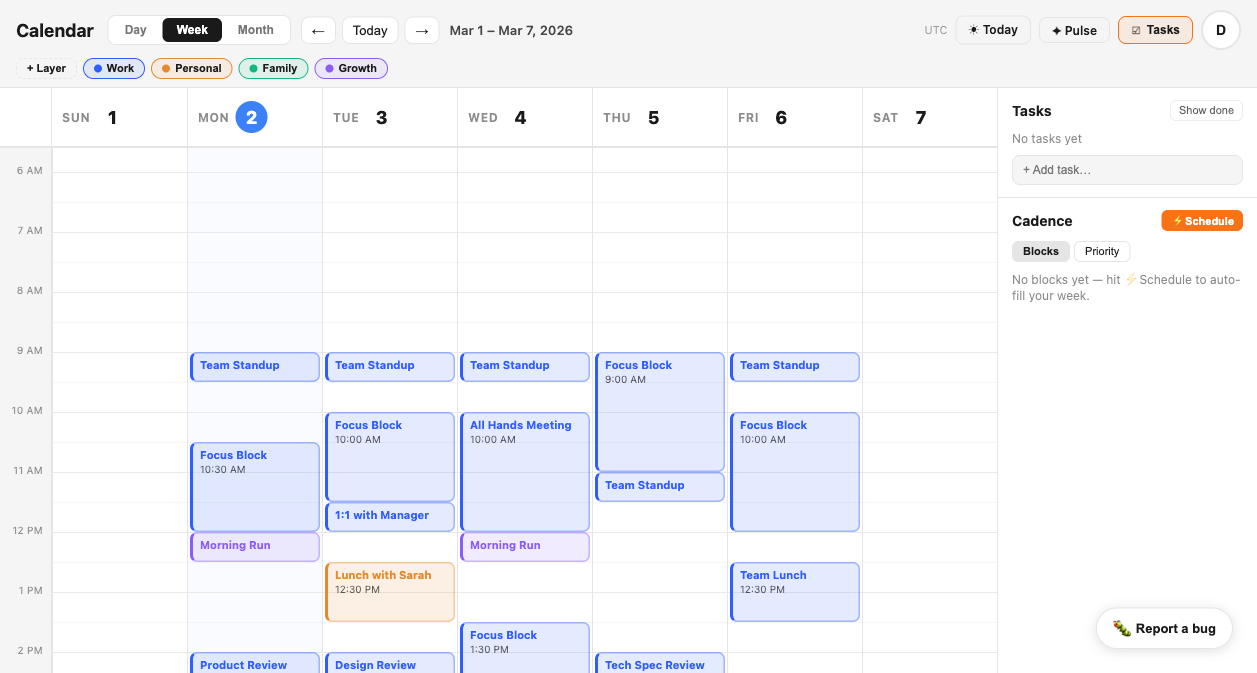
Tempo analyzes Client Work, Firm Obligations, Business Development, and Personal time as distinct layers. The composition of your week is legible before it runs — and SIGNAL surfaces the imbalances before they show up on the timesheet.
When billable and non-billable look identical,
the ratio stays invisible until billing.
A filing deadline for Matter A, a deposition for Matter B, a client call for Matter C — all in the same week. On a standard calendar, they share the same visual weight and there is no signal for which is at risk when the week fills in around them. Tempo surfaces the pattern before the deadline pressure becomes a crisis.
Internal meetings, committee work, mentorship, and firm administration do not announce themselves as billable time competitors. They book in 30-minute and 60-minute increments across the week. By the time the pattern is obvious, a significant share of billable capacity is already committed to non-billable work.
Knowing your actual billable percentage requires manually tallying event durations across client matters and everything else. Nobody does that consistently. So the ratio drifts invisibly — and the gap between hours worked and hours billed only surfaces when it is already sunk.
Tempo analyzes a legal practice
by the categories that matter.
Client Work, Firm Obligations, Business Development, and Personal have fundamentally different implications for your practice and your billing. Tempo tracks each as a distinct layer so the real composition of your week is visible — not just a list of events that all look the same.
Every billable hour — client calls, depositions, court appearances, drafting, research, and matter review. The layer SIGNAL monitors most closely. When Client Work is shrinking as a share of the week, Tempo shows it before the timesheet does.
Internal meetings, committee work, CLE requirements, mentorship, and firm administration. Non-billable, necessary, and the category most likely to expand into client capacity undetected. A dedicated layer makes the encroachment visible before it consumes a meaningful share of the week.
Client development, networking, speaking engagements, bar association work, and relationship maintenance. Investment in future work — and the first category to go dark when the current matter load is heavy. SIGNAL alerts when BD has been consistently absent from the schedule.
Life outside the practice. Separated so Tempo can show when it is genuinely protected versus when client or firm obligations have quietly consumed it. The boundary only holds if it is visible — and detectable when it is eroding.
See your real billable ratio
before the timesheet does.
Client Work at 48%. Firm Obligations at 29%. The picture is immediate — more than a quarter of your capacity is going to non-billable work. That ratio does not surface in a standard calendar. It only shows up as a billing number that does not match the hours you feel like you worked — when the gap is already sunk.
SIGNAL monitors your layer ratios and surfaces alerts in your weekly PULSE when non-billable time is expanding into client capacity, or when BD has been consistently absent from the schedule. Not a report to run manually — a signal that finds you before another week drifts the same direction.
All matters visible. Nothing competing invisibly.
What you get that you don't have now.
See your billable ratio
before the timesheet does.
Connect your calendars in under two minutes. Layers organized by work category — Client Work, Firm Obligations, Business Dev, Personal. SIGNAL monitoring your billable ratio and alerting when firm obligations expand into client capacity. PULSE delivering the real picture of your week — not what you planned, but what actually happened to your hours.