Active listings consume
your calendar. Prospecting
disappears quietly — until it doesn't.
Real estate agents live on their calendar — showings, client meetings, open houses, closings, and prospecting all compete for the same hours. A standard calendar can't show you whether your time is going to the work that pays now or the work that pays next quarter. Both categories look identical on any given Tuesday.
Tempo analyzes your activity mix — not just displays it. Separate active client work from pipeline-building from admin. See the composition of your week at a glance. SIGNAL alerts you the moment prospecting goes dark during an active listing cycle — before the gap turns into a dry quarter.
Active deals crowd out future deals.
The calendar hides it until it's too late.
When you have active buyers or listings, the calendar fills with showings, open houses, and client calls. Prospecting — the activity that generates future clients — disappears entirely. The work that pays now crowds out the work that pays next quarter, and the cycle repeats every time a deal closes.
Contracts, follow-ups, disclosures, scheduling, and CRM updates don't fit neatly into business hours when active clients need daytime attention. Without a dedicated admin layer, this work invisibly colonizes evenings and personal time — and you can't see the pattern until burnout is already setting in.
A showing, an open house, a prospecting call, and a listing agreement review all look identical in a standard calendar. You can't see the ratio of pipeline-building to deal-executing activity. That means you can't tell whether your time is allocated toward the activities that actually generate commissions.
Structure built around the revenue math.
Showings, prospecting, admin, and personal time have completely different revenue timelines. A standard calendar treats them identically. Tempo tracks each as a separate layer — so the composition of your week is visible, the drift from pipeline-building to execution is detectable, and SIGNAL fires before the damage is already done.
Active buyer and seller work — showings, open houses, listing presentations, client meetings, closings, and deal-related calls. The work that generates commissions now, tracked as its own category so the hours are always visible.
Cold outreach, database follow-ups, networking events, referral cultivation, and lead generation. The activity that generates commissions later — and the layer SIGNAL watches most closely for gaps during active listing periods.
Contracts, disclosures, CRM updates, scheduling, and compliance paperwork. Non-revenue-generating by nature, but necessary. Tracked separately so encroachment into prospecting or client time is visible before it compounds.
Life outside the business. Real estate has no natural off switch, which makes a Personal layer especially important — it creates a visible boundary that makes it detectable when work is consistently displacing personal time.
Know when active deals are eating your future pipeline.
The classic real estate trap: you land a listing, the calendar fills with active client work, and prospecting drops to zero. Three weeks later the deal closes. Two weeks after that, the pipeline is empty. SIGNAL detects when the Prospecting layer goes dark — and fires an alert before the gap turns into a dry quarter you can't explain.
When Client/Showings is 70% of your week and Prospecting is 0%, the imbalance is immediate and visible. That ratio doesn't surface in a standard calendar — it only shows up as lower production three months from now.
SIGNAL also watches when admin is expanding into evenings and personal time — and surfaces it in your weekly PULSE before another week runs the same pattern.
Showings, prospecting, admin, personal. Every category visible — every week.
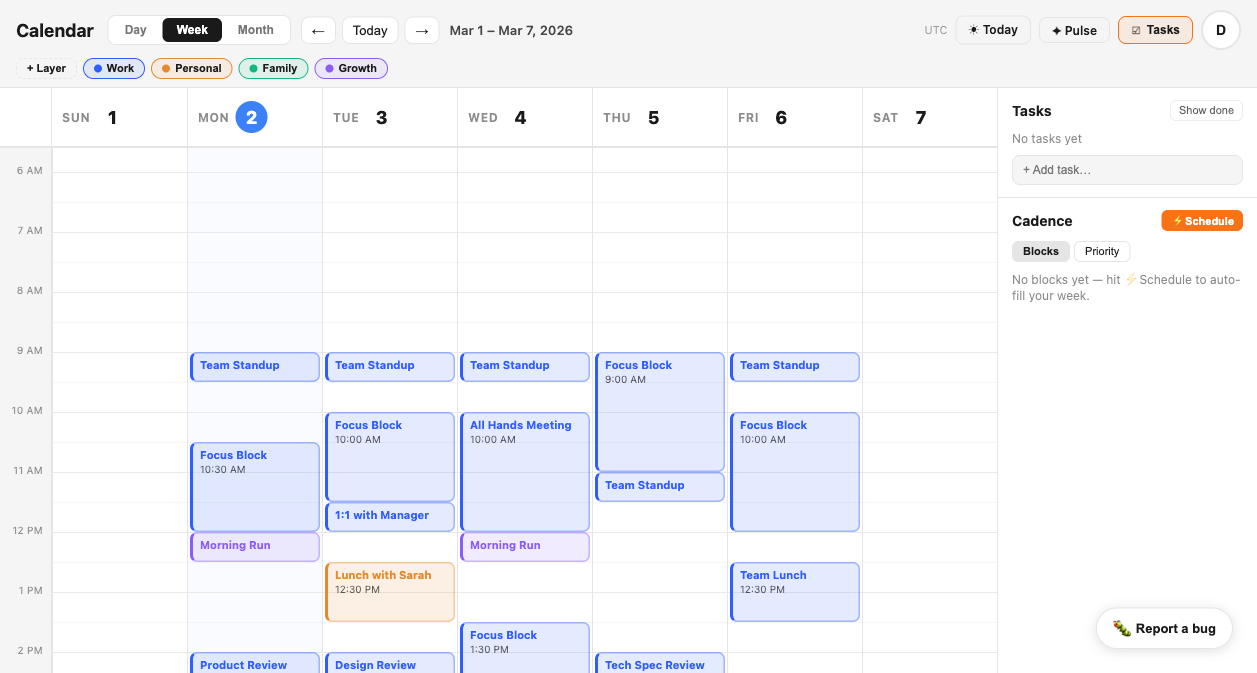
What you get that you don't have now.
Your revenue time.
Visible — not hidden in a list of events.
Connect your calendars in under two minutes. Layers organized by activity type. SIGNAL watching for prospecting gaps during active listing cycles. PULSE delivering the honest picture of your week — not what you planned, but what the data shows. Put your calendar to work.