Sunday at 7pm. You just
opened your calendar.
Now you feel it.
That Sunday dread is your brain recognizing that Monday is unmanageable. Back-to-back meetings with no prep time. A week you haven't thought through. Priorities you haven't set. Your calendar shows the problem — it's not built to solve it.
PULSE closes last week with real data. The Executive Brief opens Monday with structure — delivered before your first meeting. By the time Monday starts, the anxiety has already converted into intention.
Why Sunday anxiety is a calendar problem
Know what Monday holds before Sunday ends.
PULSE closes last week with data. The Executive Brief opens next week with structure. Sunday becomes preparation — not the start of dread.
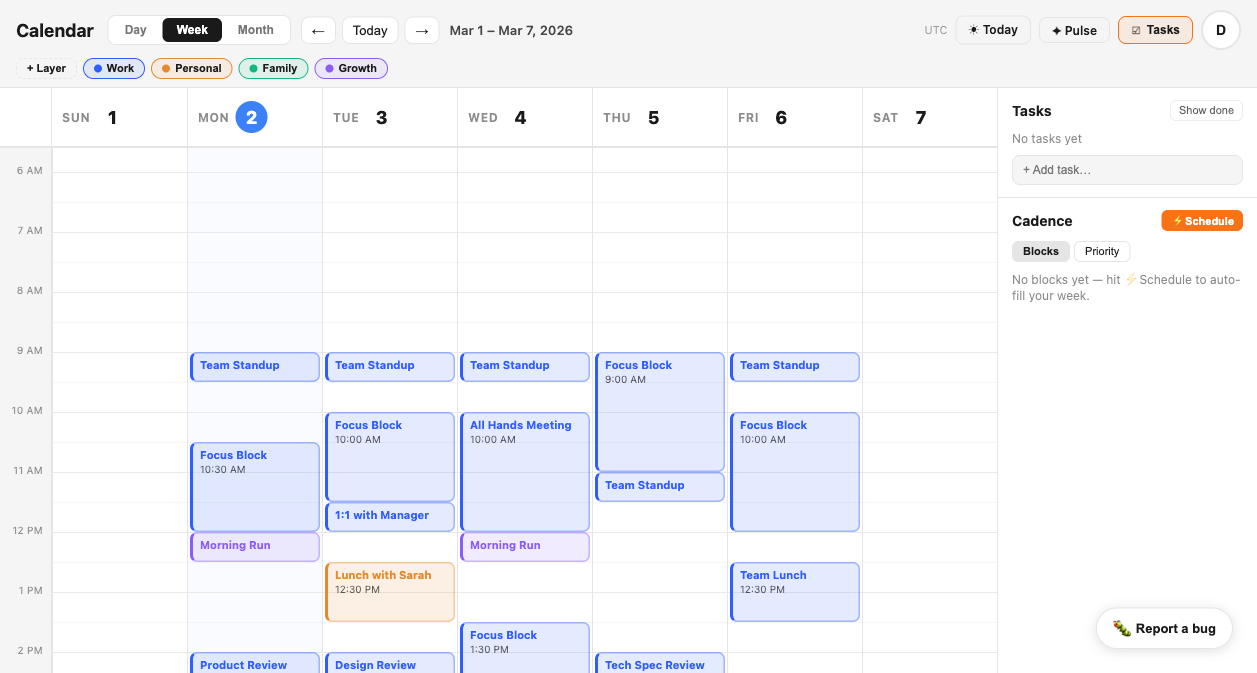
Your calendar shows the problem. Tempo solves it.
Standard calendars display what's scheduled. Open Monday and you see the meetings. But seeing the meetings is not the same as being ready for them. There's no synthesis of priorities. No flagging of the blocks with no prep time. No moment where you consciously decide how to approach the week.
Sunday dread is triggered not by seeing the calendar — but by what the calendar reveals: back-to-back meetings with no breathing room, a full week you haven't thought through, a Monday you're about to enter without a plan.
Tempo is built for the transition — to review, reflect, and arrive at Monday with the uncertainty already converted into structure.
Close last week.
Open next week.
Start Monday ready.
Tempo builds a week-transition ritual around two moments: PULSE on Sunday, and your Executive Brief on Monday morning. PULSE asks you to reflect on last week's actuals — what really happened, how it felt, what to carry forward. The brief synthesizes what's ahead before your first meeting starts.
CADENCE blocks anchor the week before it begins — focus time, check-ins, personal commitments already on the calendar so Monday isn't a void. When you open Sunday's calendar, you're not seeing chaos. You're seeing a plan you already made.
Sunday dread is an uncertainty problem. Tempo solves it with structure — a ritual that converts the anxiety of the unknown into the readiness of the prepared.
A structured Sunday reflection: how did last week's layer composition actually look? What cadence blocks happened? What didn't? Closing the week with intention, not just letting it end.
A Monday morning synthesis — delivered before your first meeting — covering the week's priorities, key meetings, and anything that needs prep before the day begins.
Recurring blocks scheduled in advance for focus time, check-ins, and personal commitments. When the skeleton of your week is already there, Sunday's calendar isn't a blank page — it's a plan.
Tempo flags back-to-back meetings with no prep buffer — the most common source of Sunday dread — so you can see the problem before Monday and fix it while there's still time.
What changes when Sunday has a ritual.
Dread lives in the gap between what you know and what you don't. Structure closes that gap.
Every Sunday, PULSE surfaces the actual composition of your past week — what layers dominated, how your cadence held up, what didn't happen that should have. Closing the week with intention replaces dread with data.
Your Monday morning brief arrives before your first meeting — synthesizing the week ahead, your top priorities, and any scheduling conflicts. You start Monday already knowing what the day holds.
When recurring blocks are already on your calendar for the week ahead — focus time, check-ins, personal commitments — Sunday's calendar isn't a void of unknowns. It's a plan you already made.
The move from Sunday anxiety to Monday readiness is a ritual, not a moment. PULSE gives you the structure to close one week and consciously open the next — so Sunday becomes preparation, not dread.
What you get that you don't have now.
Know what Monday holds
before Sunday ends.
Connect your calendar in two minutes. PULSE surfaces last week's actuals. The Executive Brief delivers Monday's structure before the first meeting starts. Sunday dread — replaced by Sunday preparation.
Get Early Access