Your 4pm is someone
else's midnight. And they
just sent a meeting invite.
The invite lands. You accept it. You don't realize until the night before that it's a 6am call — scheduled at their comfortable 2pm. Your calendar converted the time. It said nothing about what it meant for yours.
Tempo labels every event with its originating timezone. SIGNAL flags meetings outside your working hours and surfaces the pattern of creep before it becomes the permanent shape of your day.
Why timezone scheduling is harder than it looks
Every timezone, one view — and Tempo reads the patterns.
Every event anchored to your local time. Every cross-timezone meeting labeled. SIGNAL detects when outside-hours calls are increasing — no mental math required.
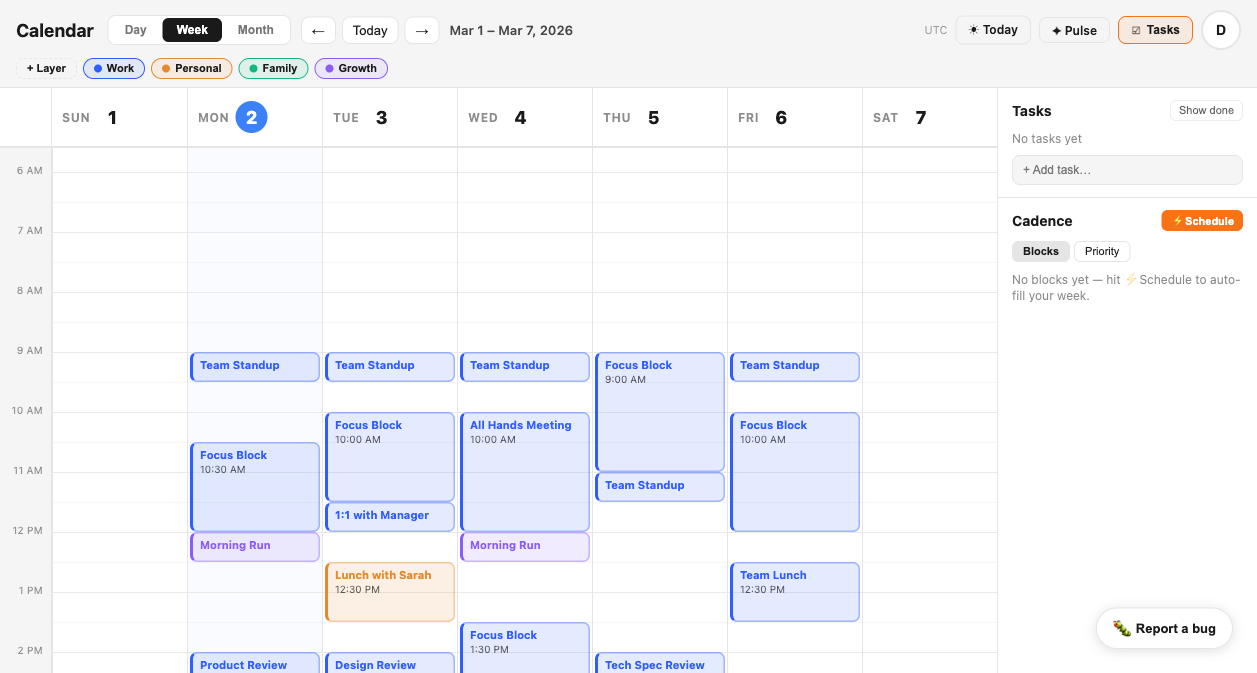
Your calendar converts timezones.
It doesn't protect you from them.
Every major calendar app can display a meeting in your local time. That's the easy part. What none of them do is understand what that conversion means for your schedule — whether the meeting is landing at a reasonable hour, whether it's eroding your mornings, whether a pattern of cross-timezone scheduling is quietly reshaping your day.
A 6am standup is just a rectangle on your Monday morning. Your calendar doesn't note that it was originally a comfortable 2pm for the person who scheduled it. It doesn't track that you've had a pre-7am call every day this week. It doesn't tell you that your working hours are slowly being consumed from the edges.
So the creep continues invisibly — one early call accepted, one late evening added — until the shape of your day belongs entirely to other people's timezones.
Timezone context on
every event. Alerts when
creep starts.
Tempo labels every event with its originating timezone alongside your local time — so you always know whether a meeting was scheduled for your convenience or theirs.
Set your working hours once. SIGNAL watches for meetings being placed outside that window and flags them — so you can decide consciously whether to accept, rather than discovering the problem at 5:45am.
Your morning brief includes timezone context for the day ahead — which calls are cross-timezone, and what that might mean for prep time and cognitive load before they start.
Every event shows both the originating timezone and your local time — no more mental math, no more guessing who scheduled it for whom.
SIGNAL detects when meetings are landing before or after your declared working hours and flags the event before you accept.
When early morning or late evening meetings are increasing in frequency, SIGNAL surfaces the trend — not just individual events.
Your daily brief includes timezone context for each cross-timezone meeting so you start the day prepared, not surprised.
What changes when timezones are visible.
Awareness changes what you accept. Once the pattern is visible, you can push back on it.
Every event displays the timezone it was created in alongside your local time — so you always know where a meeting is anchored, not just when it lands on your calendar.
SIGNAL detects when meetings are being scheduled outside your declared working hours and flags them — before they become a habit that slowly erodes your mornings or evenings.
Your daily brief includes the timezone context for each meeting — so you start the day knowing which calls are cross-timezone and what that means for prep time and mental load.
Set your working hours once. Tempo tracks when cross-timezone scheduling is steadily pushing meetings outside those hours and surfaces the pattern before it becomes a norm.
What you get that you don't have now.
Stop letting other timezones
decide the shape of your day.
Connect your calendar in two minutes. Tempo labels every cross-timezone meeting, flags outside-hours scheduling the moment it appears, and surfaces creep patterns before they become the new normal.
Get Early Access