In meetings all day.
Does any of it make your
team better?
Manager calendars fill by default — 1:1s, team syncs, cross-functional check-ins, fire-fighting. By Wednesday the week is gone and the strategic work — headcount planning, roadmap direction, hiring — has been pushed to a Friday that never comes.
Tempo analyzes the composition of your calendar so you can see what kind of manager your week is making you — and make deliberate decisions about whether that matches the kind of manager you intend to be.
Not all meetings cost the same. Standard calendars treat them like they do.
Your most high-leverage meetings. But only if you have the time between them to follow through on what comes up.
Often a symptom of communication gaps that better tooling or delegation would solve. The most commonly overscheduled meeting type for managers.
Required for coordination across teams. Frequently longer than they need to be, and rarely batched efficiently.
Reactive time that cannot be scheduled. The goal is to see how much of the week it is consuming, and whether it is trending up.
Why the capacity to lead disappears
before the week begins.
Six direct reports. Six weekly 1:1s. Stack them and you have a full morning — but unblocking, decisions, follow-ups, and feedback all require time that does not exist because the next 1:1 is already starting. The meetings designed to make your team more effective are consuming the time you need to actually do that. SIGNAL detects when 1:1 density is crowding out enabling time.
Status updates exist because the team lacks visibility. But attending every status update means spending the same hours hearing about work that you could spend removing blockers on. Most managers have never seen what percentage of their calendar is status versus enablement. Once they do, it is usually much higher than expected.
Headcount planning. Team skill gaps. Roadmap direction. Hiring strategy. These change the trajectory of a team over six months — and they require uninterrupted time to think. That time does not survive in a calendar built entirely of recurring meetings. By the time the operational load clears, the strategic window has already closed.
Your calendar — analyzed
the way managers actually lead.
Tempo adds the intelligence standard calendars cannot provide: the ability to separate enabling time from operational time from strategic time — and to know at a glance which kind of manager your week is making you before it starts.
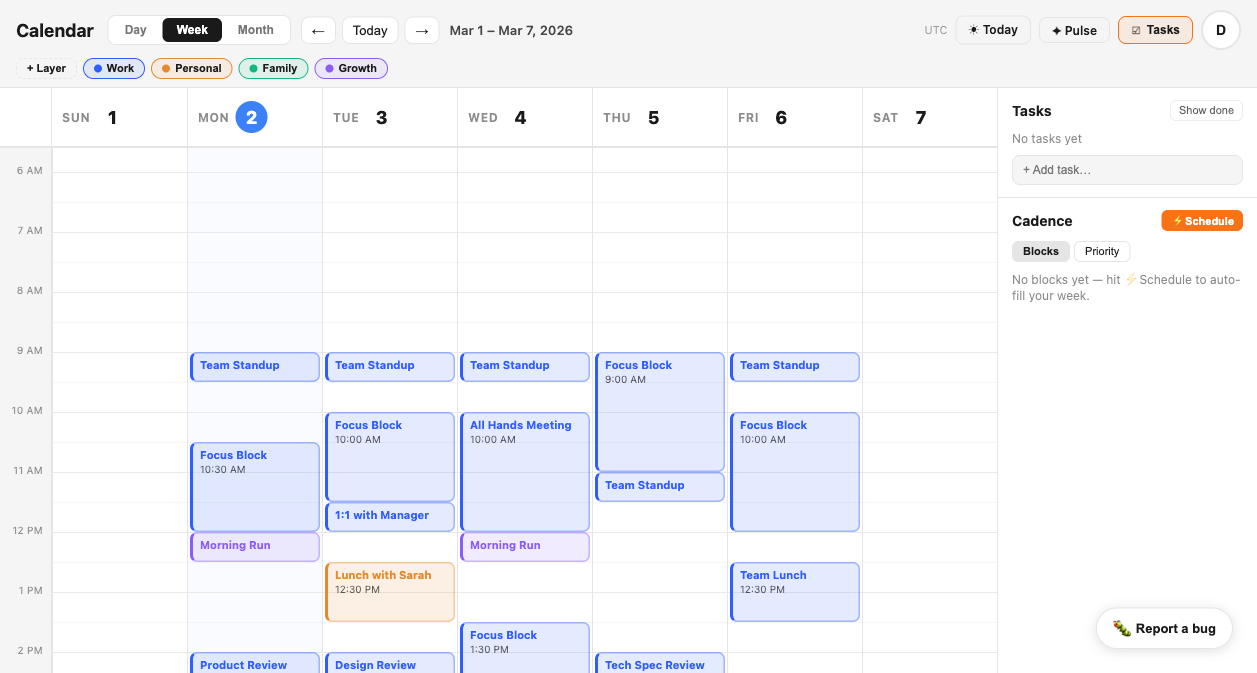
Tempo analyzes 1:1s, Team Syncs, Strategic, and Cross-functional as distinct categories. The composition of your week becomes legible at a glance — you can see whether you are in an enabling week or an operational one before the first meeting starts.
SIGNAL watches the ratio of your Strategic layer against the operational meeting load. When the calendar is running too hot on status and syncs and thinking time has disappeared, it surfaces an alert in your morning brief — not a report you will check quarterly, but a flag you see before the week runs you.
Before your first meeting, the brief shows your day organized by layer — how many 1:1s, how many team syncs, how much is cross-functional, whether any strategic time is protected. Thirty seconds of context that changes how you walk into the day and what you choose to do with the gaps.
At the end of the week, PULSE shows exactly how time was distributed across 1:1s, syncs, strategic work, and cross-functional obligations. Not what you intended. What actually happened. That is the data that makes it possible to change the shape of next week before it defaults to the same pattern.
What standard calendars
never tell a manager.
Google Calendar, Outlook, and Fantastical are built to show you what is scheduled. They are not built to tell you whether what is scheduled is making your team better — or just keeping you occupied.
Lead strategically.
Not just reactively.
Connect your Google calendar in under two minutes.
Tempo analyzes 1:1s, Team Syncs, Strategic, and Cross-functional as distinct layers. SIGNAL watches for the patterns that crowd strategic thinking out of your week. Your Executive Brief shows what kind of day is coming before the first Slack message arrives.