Full week. Nothing shipped.
Meetings took what should
have been creative time.
Marketing is one of the most meeting-heavy roles in any company. Sales alignment, brand reviews, agency check-ins, cross-functional syncs, leadership updates — each defensible on its own. Together they can consume an entire week without a single piece of content shipped or a single campaign launched.
Tempo analyzes the real ratio of creative time to operational time — and CADENCE automatically protects the work that actually produces output before coordination fills the day.
Busy week. Nothing shipped.
Tempo shows you exactly why.
Writing, design briefs, campaign concepting, content production — the work that actually generates output — fills in around the meetings. A 45-minute window between a cross-functional sync and a brand review is not time to write. It is time to check email. Creative work requires uninterrupted blocks that most marketing calendars do not have. CADENCE schedules them before the meeting load fills the day.
Marketing intersects with sales, product, design, legal, and leadership. Each relationship generates its own recurring meeting. Weekly sales alignment, biweekly brand review, monthly agency check-in, quarterly business review — each reasonable on its own. Together they consume the week that was supposed to include actual creative output.
At the end of a full marketing week: how many hours produced something — a piece of content, a campaign brief, a launched ad set, an analysis? And how many hours were spent in meetings discussing what to produce? Without layers, that ratio is invisible. Marketers feel productive and underdelivered at the same time, with no data to explain why.
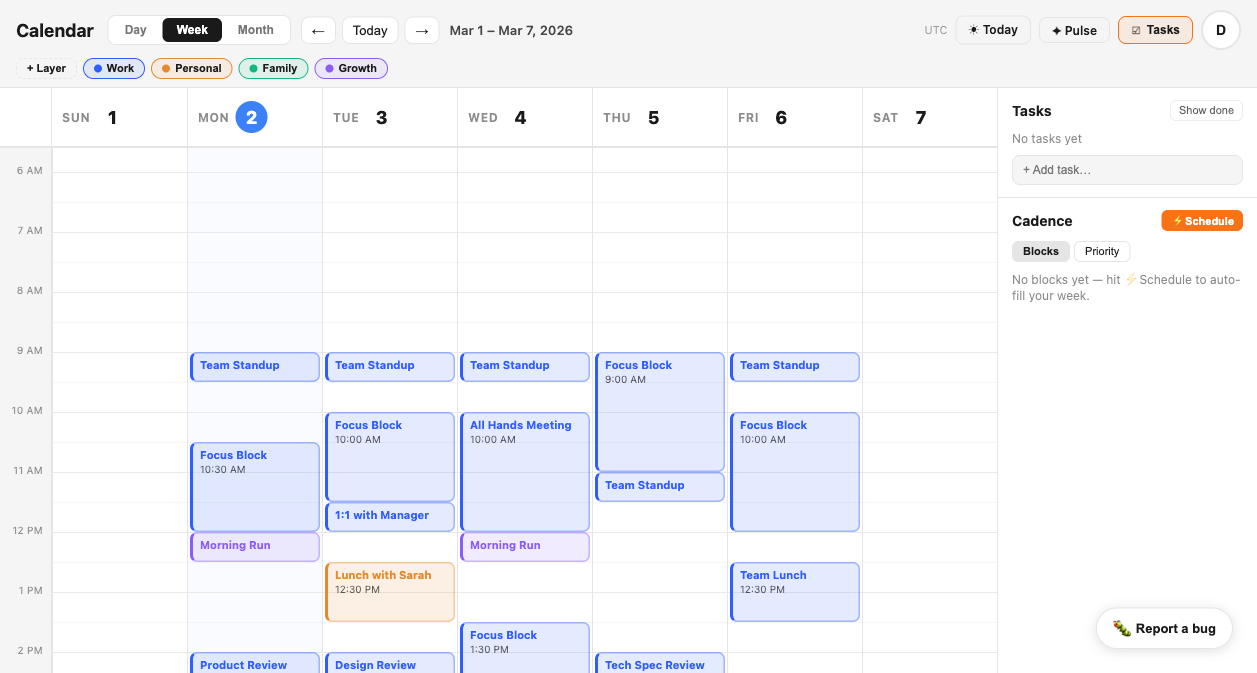
Output time and coordination time
are not the same thing.
Creative work, campaign execution, reviews, and strategy all look identical on a standard calendar. Tempo analyzes each as a distinct layer so you can see the actual composition of your week — and CADENCE protects the categories that produce output before coordination fills the day.
Writing, concepting, design briefs, content production, video scripting, copy review. The output layer. CADENCE automatically schedules these blocks before the meeting load fills the day. SIGNAL alerts when this layer shrinks below its baseline share of the week.
Campaign execution, ad management, launch coordination, performance monitoring, and A/B test setup. Active work on live campaigns tracked separately from creative development — so Tempo can show how much time each demands independently.
Cross-functional syncs, brand reviews, agency meetings, stakeholder updates, sales alignment. The coordination layer. Its own category so you can see — at a glance, before the week starts — when it is consuming more than its appropriate share.
Competitive research, channel strategy, audience analysis, planning sessions, and roadmap reviews. Neither reactive coordination nor tactical execution — and the first category to disappear when the calendar fills. SIGNAL alerts when it has gone dark.
What you get that you don't have now.
Standard calendars show you what is scheduled. They do not tell you whether your creative time is being consumed by coordination, or whether you have shipped anything in the last two weeks relative to how much time you spent in meetings.
Stop ending the week with
nothing shipped.
Connect your calendar in under two minutes. Tempo analyzes Creative Work, Campaigns, Meetings, and Strategy as distinct layers. SIGNAL alerts when output-producing work disappears from the schedule. CADENCE schedules creative blocks before coordination fills the day. Put your calendar to work.