You talk to everyone.
You have time for no one.
Especially not the product.
Product management is the most meeting-dense role in the company. Engineering. Design. Customers. Leadership. Sales. Support. You are the connective tissue between every team — which means every team has a claim on your calendar before you do.
Tempo doesn't just show your events — it analyzes them. How much of last week was customer work versus ceremony? How much was planning versus attendance? That data exists in your calendar. Tempo surfaces it before the week goes sideways.
The PM calendar problem isn't too many meetings.
It's no visibility into what they cost.
Engineering standup at 9. Design review at 10. Customer call at 11. Leadership sync at 1. Partner check-in at 2. Sales enablement at 3. By the time you sit down to actually think, the day is gone — and tomorrow looks identical.
Writing a PRD, sequencing a roadmap, making a hard prioritization call — these tasks require 90 uninterrupted minutes, minimum. Your calendar has 18 half-hour slots, none of them empty. The most important work a PM does is perpetually scheduled for never.
Backlog grooming. Sprint planning. Daily standup. Retro. Demo. That is the floor. The recurring scaffolding of agile consumes nearly two full days before a single strategic or customer conversation appears on the calendar.
You know you should be talking to customers. You also have five internal syncs that cannot move. When both categories pull on the same hours, customer time loses — consistently, quietly, and without any system that notices.
Put your calendar to work.
Know what kind of day you're walking into.
Tempo doesn't just organize your calendar — it analyzes it. Separate customer work from internal ceremonies from planning time. Surface what's being crowded out. Know before the first meeting whether today is a customer day or an attendance day.
Create layers for Work, Customer, Planning, and Growth. Assign every event to its real category. For the first time, you can see whether Tuesday is a customer day or an internal day — at a glance, before the day starts.
SIGNAL watches the ratio of your Customer layer against your Planning layer. When internal meetings push customer time below your target for more than a few days, it surfaces an alert — not buried in a report, but in your morning brief where you will actually see it.
Before your first meeting, a brief shows your day by layer: how much of today is customer-facing, how much is cross-functional, how much is planning. Thirty seconds of context that most PMs spend all day trying to piece together.
Each week, a summary of where your time actually went — broken down by layer. Not what you intended to do. What you actually did. That data is what makes it possible to have an honest conversation with yourself about whether you are doing PM work or just attending meetings.
Customer days. Internal days. Planning days. See the difference before it starts.
Tempo makes it immediately obvious whether a day is customer-heavy, ceremony-heavy, or — rarely, but it happens — actually open for strategic work.
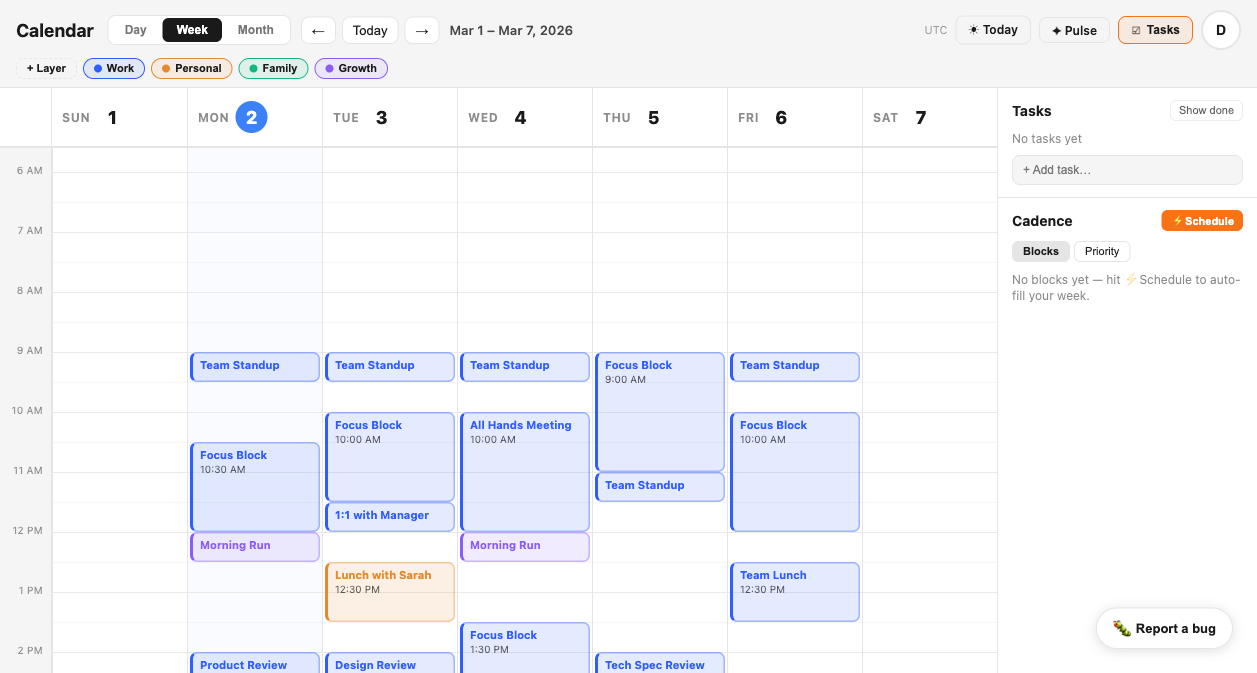
What standard calendars never tell you.
Standard calendars show events. They do not tell you whether what is on the schedule is PM work or attendance — or whether the ratio between customer time and internal ceremonies has drifted into something that will hurt the product.
Put your calendar to work.
Know what kind of PM week you're actually having.
Connect your Google calendar in under two minutes.
Layer your time by type — Customer, Planning, Work, Growth. SIGNAL surfaces when something is being crowded out. Your Executive Brief tells you what kind of day is coming before the first meeting starts. Spend less time in your calendar. More time doing the work.