5 classes. 3 deadlines.
Full social calendar. Study time?
Somewhere — but the calendar won't tell you where.
Student life means juggling classes, assignments, exams, internships, clubs, social commitments, and the need to sleep — in a calendar that treats all of these identically. There's no way to see whether the week is academically balanced or on the edge of a 2am cram session that was entirely predictable two weeks ago.
Tempo analyzes the composition of your week — not just shows it. Classes, Study, Extracurricular, and Personal in separate layers. SIGNAL alerts you when study time drops before deadlines arrive. No more surprises — just visibility.
Study time has no fixed claim on the calendar.
So it loses — every time.
Classes are fixed. Everything else — social plans, club meetings, part-time work — books itself around them. Study time has no fixed claim on the calendar, so it ends up in whatever gap remains. When the gaps fill, studying disappears. The calendar fills; the coursework doesn't.
It's easy to look at a week and feel like you're studying — until you add up how many hours actually went to classes, how many to actual study sessions, and how many to clubs, events, and social commitments. Without layers, the ratio is invisible and the drift goes undetected.
A paper due in two weeks looks identical to a coffee meeting next Thursday. Standard calendars don't signal when study time hasn't been protected in the days leading up to a major deadline. By the time the urgency is obvious, there's no buffer left.
Each time type gets its own layer. So does the drift.
Classes, study time, extracurricular, and personal life have different weights and different consequences. A standard calendar treats them identically. Tempo tracks each as a distinct layer — so the composition of your week is visible at a glance, and the drift from academics to everything else is detectable before a deadline arrives with no buffer.
Fixed class time, lectures, labs, and required attendance. The non-negotiable anchor of the academic week — tracked as its own layer so you can see immediately how much of your available time is already committed before anything else is scheduled.
Independent study sessions, assignment work, exam prep, and research. The most important layer for academic success — and the one most easily crowded out. SIGNAL watches when this layer goes thin before known deadlines.
Clubs, organizations, internships, volunteering, and campus activities. Valuable, but the layer that most often expands at the expense of study time when commitments accumulate faster than the calendar can absorb them.
Social time, rest, exercise, and everything that keeps you functional. A dedicated layer makes the boundary between academic life and personal life visible — and makes it detectable when one is consistently displacing the other.
SIGNAL alerts when study time is dropping — before the deadline confirms it.
When Study/Assignments is 8% of your week and Extracurricular is 35%, the imbalance is visible immediately. That ratio doesn't appear in a standard calendar — it only shows up as a 2am cram session the night before the paper is due.
SIGNAL watches your layer ratios and surfaces alerts when the Study layer has been thin for multiple days heading into a week with known deadlines. Not a dashboard to check — a signal that finds you in your weekly PULSE before the situation is already urgent.
The goal isn't to schedule every minute. It's to see the composition of your week clearly enough to make intentional choices — before the calendar makes them for you.
Classes, study, extracurricular, personal — each as a real percentage of your week.
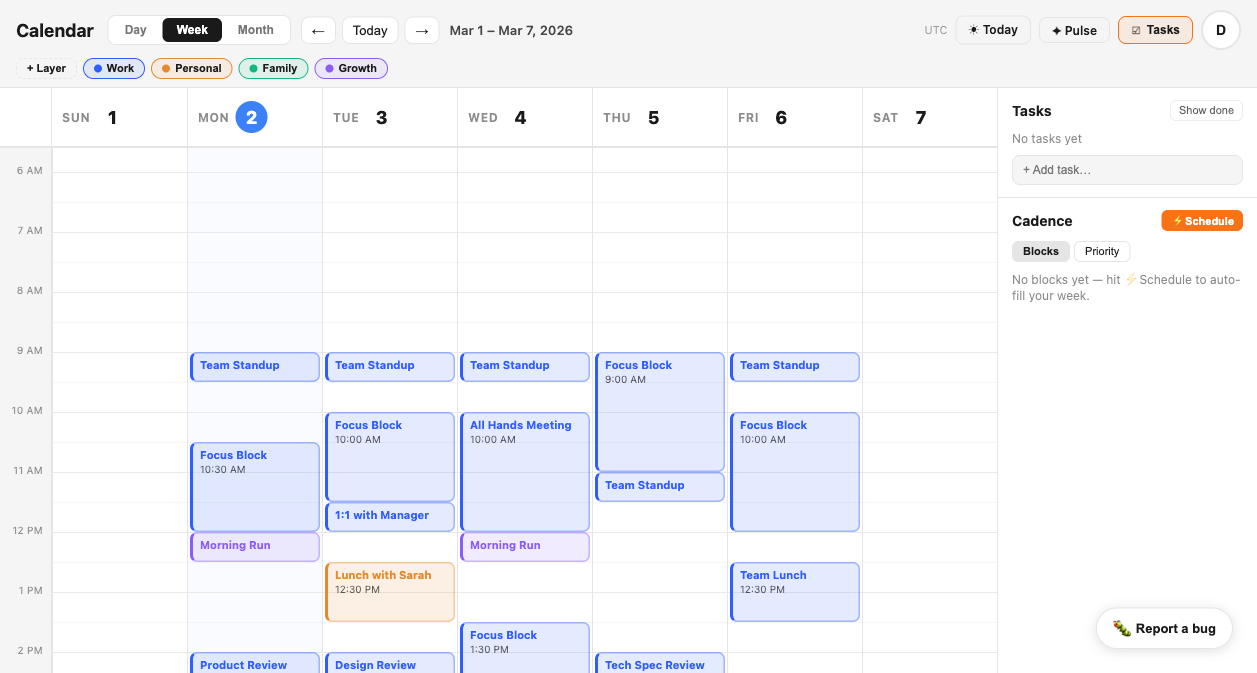
What you get that you don't have now.
Put your calendar to work.
Stop finding out about deadline gaps too late.
Connect your calendars in under two minutes. No credit card. Layers organized by time type — classes, study, extracurricular, personal. SIGNAL watching when study time drops before deadlines. PULSE showing the real composition of your week — not what landed on the calendar, but what the week actually gave the work.